Medicai DICOM Viewer opens CT scans, MRIs, X-rays, ultrasounds, and PET studies in any browser — zero-footprint, no installation, HIPAA-compliant — so clinical teams can view, share, and collaborate on medical imaging from any device, anywhere.


Medicai DICOM Viewer is a zero-footprint DICOM viewer for web and mobile that helps imaging teams open studies fast, collaborate securely, and keep workflows inside one viewing experience.

Compatible with Chrome, Firefox, Safari, and Edge on Windows, macOS, and Linux. Native apps available for iOS 14+ and Android 8+. Medicai DICOM Viewer runs in the browser and supports iOS and Android, so clinicians can access studies without installing desktop software or managing workstation updates.
Medicai combines viewing with Cloud PACS storage and retrieval so teams can pull studies and priors without repeated exports, which supports longitudinal comparison and cross-site access.
Medicai combines viewing with Cloud PACS storage and retrieval so teams can pull studies and priors without repeated exports, which supports longitudinal comparison and cross-site access.
Includes windowing and levelling (W/L), linear and area measurements, multiplanar reconstruction (MPR), cine playback for cardiac and fluoroscopy studies, side-by-side comparison, and annotation tools. Medicai DICOM Viewer supports controlled sharing and team collaboration, so clinicians can review the same study across locations without relying on file transfers.

Medicai DICOM Viewer removes common imaging bottlenecks by making studies easy to access, easy to compare, and easy to share, without installs or file transfers.
Medicai runs in the browser and on mobile, so clinicians can open studies from approved devices without local setup or updates.
Medicai supports side-by-side comparison and clinical tools so teams can review change over time without exporting files.
Medicai enables controlled sharing for second opinions and care coordination, so teams collaborate on the actual study, not screenshots.
Medicai handles standard DICOM imaging so inbound studies behave consistently in one viewer.
Medicai's DICOM Viewer is HIPAA-compliant — all studies are transmitted over TLS encryption, access is controlled by role-based permissions, and every study access event is logged for audit purposes. Medicai supports cloud-based access patterns so multi-location teams can review studies without local storage constraints.
Medicai supports embedding and API-based integration so viewing happens inside your product or clinical journey, not in a separate tool.
See your first study loaded and shared during the demo. Use your own data or a sample study.
Give it a try, play with it! Using our embeddable DICOM Viewer, you can easily view your DICOM files anywhere online (web, in the mobile application). Your DICOM files are stored in your Medicai workspace, in your cloud PACS.
For a quick view of a single DICOM study with no account required, use the free online DICOM Viewer — no sign-up, no installation, available instantly. For clinical teams needing secure storage, worklists, priors access, and PACS integration, this is the product for you.


"Definitely this application provides us with fast, remote imaging acquisitions. In addition, we can always make comparisons between different cases, we can make databases, we can make collections on different pathologies, we can collect special cases, I mean it's actually a mini real-time library, extremely, extremely useful for neurologists, for neurosurgeons, for surgeons, for oncology, for hematology."
Armand Frăsineanu, MD


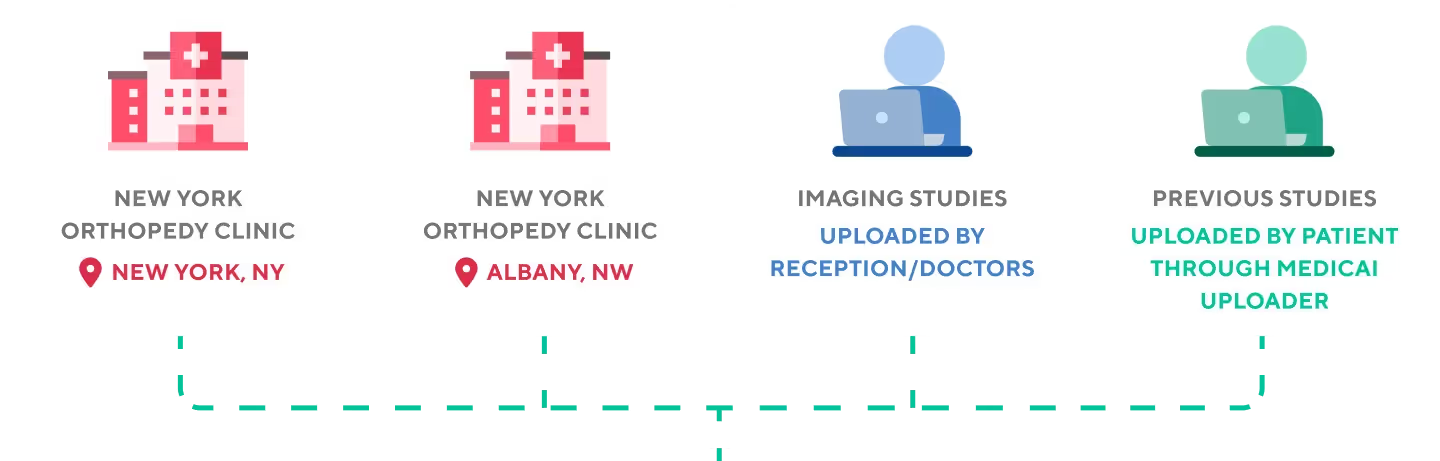
Imaging data is retrieved automatically from the local imaging infrastructure (PACS, modalities), but it can also be uploaded manually by the receptionist, doctors or even by the patient through our Medical Imaging Uploader. Data can be accessed and viewed through Medicai DICOM viewer, from anywhere, and at any time. Our viewer supports DICOM worklists and enables doctors to easily navigate many images, making it an ideal tool for busy medical practices. Doctors can easily view patient history and previous scans, making it easier to track changes over time. Additionally, the platform enables seamless export of DICOM images for further analysis or sharing with other healthcare providers.
The imaging data is stored on our scalable and secure imaging infrastructure. Our Cloud PACS has built in granular access control levels, enabling precise sharing of data inside the organization, and outside. Thanks to our robust API the imaging data is readily available. This makes the implementation of advanced imaging workflows a breeze.
Our platform enables healthcare facilities to easily incorporate cutting-edge imaging solutions into their workflows without specialized DICOM expertise. Any healthcare organization can easily and securely view imaging data from anywhere by embedding our DICOM viewer in their portals or apps, as simple as pasting a line of code.

Team members can access, view, share and collaborate easily with our ready made web portal for doctors and mobile apps for doctors.
Our optimized zero-footprint DICOM Viewer is available in our Medicai Portal and mobile apps. Doctors can view any medical imaging instantly, in minutes after the imaging investigation has been performed. With its user-friendly interface and powerful features, including advanced visualization tools and annotation capabilities, Medicai facilitates efficient communication and collaboration among clinicians, including medical students. This software enables multiple users to simultaneously access and work on the same image, promoting collaborative discussions and enhancing diagnostic accuracy across different use cases.
Whether sharing findings, seeking second opinions, discussing treatment plans, or conducting research, Medicai DICOM Viewer empowers clinicians, including medical students, to collaborate effectively in optimal patient care.

Medicai’s DICOM Viewer is built for teams that need fast study access, secure collaboration, and a viewer that fits real clinical workflows, not a standalone tool that adds another login.
Medicai loads studies in the browser, so teams avoid workstation installs and reduce time-to-first-image.
Medicai supports controlled sharing for second opinions, referrals, and team review, so decisions happen on the real study, not on exported files.
Medicai includes comparison and measurement tools that support daily interpretation workflows and longitudinal review.
Medicai pairs viewing with Cloud PACS storage and retrieval, so you can start with viewing and scale into priors, retention, and multi-site access when needed.
Medicai supports embedding and API workflows, so viewing can live inside your portal, EHR-linked experience, or care coordination journey.
Medicai supports access discipline and auditability so IT teams can manage who sees what, and when, without losing speed.
What should we evaluate during the demo?
Bring one real workflow. Test study loading speed, priors access, external sharing, and how results and annotations fit your clinical collaboration process. Ask for the exact setup steps and the operational owner for support.
Is the viewer intended for primary diagnosis?
Confirm the intended use in your environment. Many web viewers are used for review, collaboration, and communication workflows. If you need primary diagnostic use, align on regulatory status, calibration requirements, and clinical governance before rollout.
How do you handle access control and auditability?
Treat this as a go or no-go requirement. Your viewer should support role-based access, time-bound sharing, and auditable logs for viewing and sharing events. Validate which controls are available in your deployment and what is configurable.
What systems can it integrate with?
Medicai is designed for standards-based imaging integration and API workflows. Integration scope usually includes study access, user identity and permissions, and optional workflow signals. Align the integration plan to your environment during discovery.
What does a typical rollout look like?
Most teams start with a pilot that proves three outcomes, first study access, first external share, and first cross-site collaboration workflow. Timeline depends on integration scope, data sources, and security requirements.
Can we embed the viewer in our portal or application?
Yes. Medicai supports embedding and API-based integration so viewing can live inside your existing clinician or patient experiences, rather than sending users to a separate tool.
Can we share studies outside the hospital, for second opinions or referrals?
Yes. Medicai supports shareable access flows designed for collaboration. The right version is controlled access with auditability, not file emailing. Confirm the access controls your team requires during setup.
Do users need to install software to view DICOM studies?
No. Medicai’s DICOM Viewer runs in the browser, so clinicians can open studies without local installs or workstation dependencies.
Can DICOM images be emailed safely to another provider or patient?
Yes, you can email DICOM images, but you must use proper encryption and security measures. DICOM files contain sensitive patient information, so sending them without encryption can break privacy laws like HIPAA. Use secure email platforms or encrypted ZIP files for safe and compliant transfer.
What are DICOM images?
DICOM images are medical images saved in the DICOM (Digital Imaging and Communications in Medicine) format. They include both the image, such as an X-ray, CT, or MRI, and important patient data like name, ID, and scan details. It provides safe and standard image sharing and viewing across healthcare systems.
What is the average file size of compressed vs. uncompressed DICOM images?
Uncompressed DICOM images can range from 5 MB (X-ray) to over 500 MB (MRI or CT series). Compressed DICOM files that use JPEG 2000 or lossless formats are usually 30–70% smaller, depending on the modality and resolution. Compression lowers storage costs without affecting diagnostic image quality significantly.
Is there a free DICOM viewer that supports 3D imaging?
Several free DICOM viewers support 3D imaging, including Medicai free DICOM Viewer, RadiAnt (with a free trial), Weasis, and Horos (for Mac users). These tools help view CT and MRI scans in various planes or as 3D images, ideal for radiology review, education, or research without a license fee.
What types of files use the DICOM standard?
The DICOM standard is used for medical images like X-rays, CT scans, MRIs, ultrasounds, PET scans, and radiation therapy images. These files contain both the images and important patient information. It helps doctors and healthcare providers easily view, store, and share these images across different medical systems.
Can DICOM work with HL7 or FHIR for medical image sharing?
DICOM handles storing and sharing medical images. HL7 and FHIR manage patient data and clinical processes. Together, they offer safe and complete sharing of images. DICOM manages the images, while HL7 or FHIR links patient records, orders, and reports in healthcare systems.
Can you download DICOM images from a hospital or PACS system?
You can download DICOM images from a hospital or PACS system, but only authorized users can access them. Patients can request copies through a patient portal or the medical records department. Downloads usually come in DICOM format, that are viewable with free DICOM viewer software for personal or clinical use.
Can DICOM files be encrypted for secure transmission?
Yes. You can encrypt DICOM files using TLS (Transport Layer Security) to keep data safe during transmission. It keeps patient information and medical images private and protected when shared over networks. It also helps meet compliance standards like HIPAA and supports safe teleradiology and remote diagnostics.
Can you convert DICOM to JPEG and other formats?
Yes, you can convert DICOM files into JPEG, PNG, PDF, NIfTI, STL, and other formats using specific software or tools like the Medicai DICOM viewer. These conversions help you to share, view, or process medical images outside of clinical systems while keeping their diagnostic quality intact.
How to convert DICOM images to JPEG?
You can convert DICOM images to JPEG using Medicai’s Free Online DICOM Viewer. Go to the Medicai viewer and upload your .dcm file. Once the image loads, click Export and select JPEG. Download your high‑resolution JPEG—no software install required and fully HIPAA‑compliant.
What is the app that opens DICOM images?
The app that opens DICOM images is Medicai DICOM Viewer. It caters to various use cases in medical imaging collaboration, offering seamless access to images stored in various data storage systems, including Picture Archiving and Communication Systems (PACS).
Medicai is the ideal solution for healthcare providers to easily review and analyze DICOM images thanks to its easy-to-use interface and advanced features like annotation and visualization tools.
Whether for sharing findings, seeking second opinions, or discussing treatment plans, Medicai DICOM Viewer facilitates efficient communication and collaboration, ultimately enhancing diagnostic accuracy and patient care.
Is there a free DICOM viewer?
Yes. The leading option is Medicai’s Free Online DICOM Viewer—a browser‑based, zero‑install tool that lets you view, pan/zoom, measure, and securely share DICOM images with full HIPAA compliance. Other notable free viewers include: MicroDicom, RadiAnt DICOM Viewer, Weasis: Free DICOM viewer, and IMAIOS Dicom Viewer.
Seamlessly retrieve, view, store, and share medical imaging data with a robust multi-location, cloud PACS storage, zero-footprint DICOM viewers, AI support, and best-in-class sharing capabilities.
Other Medicai Products
CONNECT & RETRIEVE
STORE & MANAGE
ACCESS, VISUALIZE, COLLABORATE


Get the Medicai Mobile App


Investigations
Medical ImagingPET CT ScanMRI ScanCT ScanMammogramsAngiographyMR AngiographyUltrasoundDEXA Scans


